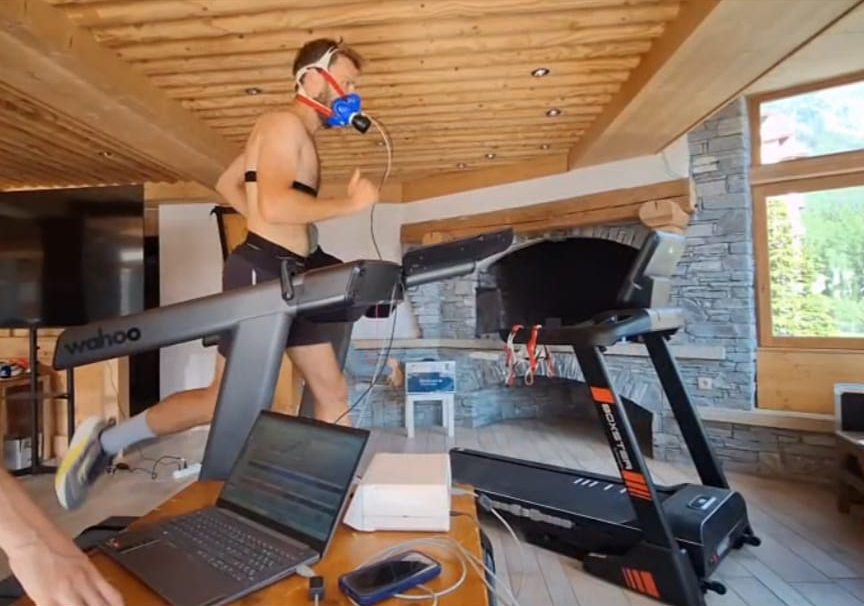
Before UTMB I did a VO2 max test at Enduraw, a testing centre, in August 2026. I used it to build a race simulation, which I compared with the one on the UTMB website, very accurate on the day.
Not medical advice. This is my personal experience. Before a stress test or an ultra-trail project, ask a doctor for advice.
Planned vs actual
My two simulations, taken from my game plan, compared with my real times from the official tracking. Race time when leaving the life bases; in brackets, the gap between real and planned.
Checkpoint
Km
Enduraw
LiveTrail (UTMB)
Actual
Les Contamines
32.4
4:17 (+0)
4:13 (+5 min)
4:17:31
Courmayeur (exit)
81.3
12:44 (+7 min)
12:28 (+23 min)
12:51:10
Champex-Lac (exit)
127.5
20:56 (+20 min)
21:18 (−2 min)
21:16:04
Vallorcine (exit)
155.3
26:13 (+28 min)
26:57 (−16 min)
26:40:51
Chamonix (finish)
173.6
29:22 (+36 min)
29:59 (−1 min)
29:57:58
The most accurate: LiveTrail, the UTMB website’s simulator. It predicted 29 h 59 at the finish, with a range of 28 to 32 h, and I finished in 29 h 58. Across the five points it was off by 9 minutes on average, against 18 for Enduraw. Enduraw was very accurate in the first half, within seconds at Les Contamines and 7 minutes at Courmayeur, but too optimistic afterwards: 36 minutes off at the finish.
The VO2 max test
My VO2 max test at Enduraw, August 2026
I left it too late. Done earlier, it could have shaped my training better.
I did it at Enduraw, but other centres offer it. The debrief was interesting, especially for working on my ventilatory threshold and bringing my endurance closer to my maximum capacity.
I would do it again, but much earlier: it can really change a build-up.